
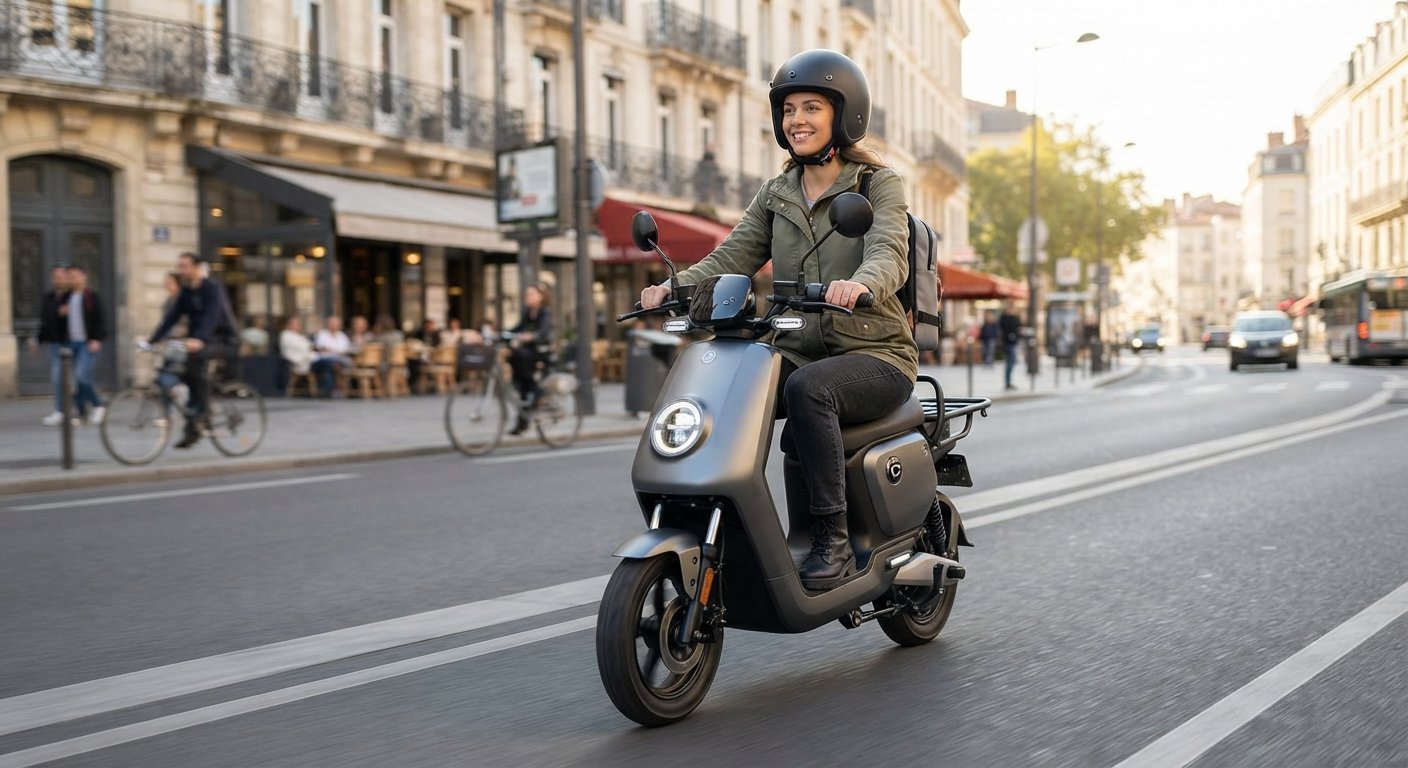
A moped is a small, lightweight motor vehicle designed for economical short-distance travel. Traditional mopeds typically combine a small engine with bicycle-like features, while modern models may use electric motors and look more like compact scooters. They are popular with commuters, students, and riders who want an inexpensive alternative to a full-size motorcycle or car. However, the exact definition, speed limits, registration requirements, and licensing rules vary by jurisdiction. Understanding those differences is essential before buying or riding one.
Quick Answer: A moped is a lightweight, low-powered two-wheeled vehicle intended mainly for short trips and efficient transportation. Depending on the model and local law, it may have a small gasoline engine or an electric motor. Legal requirements vary considerably by location.
What Is a Moped?
A moped sits somewhere between a bicycle and a motorcycle in terms of size, power, and design.
The word historically combines “motor” and “pedal,” reflecting the design of early mopeds, which could be powered by a small engine while also retaining pedals. Modern mopeds do not always have functional pedals, so the everyday meaning has expanded beyond the original design.
Typical characteristics include:
- Lightweight construction
- Two wheels
- Relatively low power
- Modest maximum speed
- Small engine or electric motor
- Simple controls
- Good fuel or energy efficiency
- Suitability for short urban journeys
The exact technical definition is not universal. One country’s legal definition of a moped may be different from another’s.
How Does a Moped Work?
A conventional gasoline-powered moped uses a small internal-combustion engine to turn the rear wheel.
The basic process is straightforward:
- Fuel and air enter the engine.
- Combustion produces mechanical energy.
- The engine transfers that energy through the drivetrain.
- The rear wheel turns.
- The rider controls acceleration, braking, and steering.
Electric mopeds work differently. A battery supplies electricity to an electric motor, which converts electrical energy into movement.
Gas vs. Electric Mopeds
| Feature | Gas Moped | Electric Moped |
|---|---|---|
| Power source | Gasoline | Rechargeable battery |
| Engine | Small combustion engine | Electric motor |
| Refueling | Fuel station | Electrical outlet/charger |
| Noise | Higher | Generally quieter |
| Maintenance | Engine-related maintenance | Fewer moving drivetrain components |
| Emissions at use | Produces exhaust | No tailpipe exhaust |
| Range | Depends on fuel tank | Depends on battery capacity |
| Best suited for | Longer or fuel-based travel | Short urban trips and charging access |
Electric models have become an increasingly visible part of the small-mobility market, but the right choice depends on distance, charging access, local regulations, and purchase price.
Moped vs. Scooter: What’s the Difference?
The terms moped and scooter are often used interchangeably in everyday conversation, but they are not necessarily the same thing.
A scooter typically has a step-through frame, a floorboard for the rider’s feet, and a seat. Many modern scooters use automatic transmissions and can have significantly more power than vehicles legally classified as mopeds.
A moped, by comparison, generally refers to a lower-powered vehicle class.
Key Differences
| Category | Moped | Scooter |
|---|---|---|
| Typical power | Lower | Low to high, depending on model |
| Speed | Generally modest | Can be substantially higher |
| Frame | Varies | Usually step-through |
| Pedals | Traditional designs may have them | Usually none |
| Engine/motor | Small | Varies considerably |
| Intended use | Short trips | Urban to longer-distance riding |
The most important point is that appearance does not determine legal classification.
A vehicle that looks like a scooter may legally be classified differently depending on its motor, power, maximum speed, and other specifications.
Moped vs. Motorcycle
A motorcycle is generally larger, more powerful, and capable of higher speeds than a moped.
Motorcycles are designed for a wider range of riding conditions, including longer journeys and higher-speed roads. Mopeds are usually optimized for low-speed transportation and short urban trips.
Which One Is Better?
It depends on the job.
A moped may make more sense if you want:
- Low running costs
- Easy city transportation
- A lightweight vehicle
- Simple parking
- Short-distance commuting
A motorcycle may be better if you need:
- Higher cruising speeds
- Longer-distance travel
- More carrying capacity
- Better performance on faster roads
- Greater engine power
Choosing between them based only on purchase price can be misleading. Insurance, registration, fuel or charging costs, maintenance, protective equipment, and licensing requirements should all be considered.
Are Mopeds Good for Commuting?
For the right commute, a moped can be highly practical.
Imagine a person traveling 8–12 kilometers each way through a busy urban area. A small two-wheeler may require less parking space than a car and can be considerably easier to maneuver through slow-moving traffic.
Mopeds are particularly attractive for:
- Short city commutes
- Campus transportation
- Neighborhood travel
- Errand running
- Delivery work where legally permitted
- Trips where parking is difficult
However, they are not ideal for every commute.
A route involving high-speed highways, poor road surfaces, extreme weather, or long distances may require a different type of vehicle.
How Much Does a Moped Cost?
The purchase price varies dramatically according to the model, brand, powertrain, battery size, equipment, and local market.
But the purchase price is only one part of the calculation.
Consider the total cost of ownership, including:
- Purchase price
- Registration
- Insurance
- Fuel or electricity
- Routine maintenance
- Tires
- Brakes
- Battery replacement for electric models
- Safety equipment
- Parking
An inexpensive vehicle can become less economical if it requires frequent repairs or expensive replacement parts.
New vs. Used
A used moped can offer a lower entry price, but condition matters.
When inspecting a used model, check:
- Cold-start behavior
- Brake operation
- Tire condition
- Steering
- Lights and indicators
- Suspension
- Frame damage
- Battery condition on electric models
- Service history
- Registration documents
- Vehicle identification number
If possible, have a qualified mechanic inspect a used vehicle before purchase.
Electric Mopeds: What Should You Check?
Electric mopeds can be attractive because of their quiet operation and relatively simple drivetrain.
But the battery is a critical component.
Before purchasing an electric model, look at:
Battery Capacity
Battery capacity affects how much energy the vehicle can store. A larger battery can potentially provide more range, although actual range also depends on speed, rider weight, terrain, temperature, and riding style.
Charging Time
Consider how long a full charge takes and where you will charge.
If you commute every day, home charging may be more important than having an impressive theoretical range.
Real-World Range
Do not rely exclusively on the manufacturer’s maximum range figure.
Your actual range can be lower when:
- Riding at higher speeds
- Carrying additional weight
- Traveling uphill
- Riding in cold conditions
- Frequently accelerating
- Using electrical accessories
For daily commuting, calculate your expected round-trip distance and leave a reasonable buffer.
Do You Need a License for a Moped?
This is one of the most important questions, and there is no single worldwide answer.
Moped licensing requirements vary by country, state, province, and sometimes vehicle classification.
Depending on where you live, you may need some combination of:
- A driver’s license
- A motorcycle or moped endorsement
- Registration
- Insurance
- Helmet compliance
- Minimum age requirements
- Safety training
- Vehicle inspection
Some jurisdictions have special licensing categories for low-powered two-wheelers, while others regulate them under broader motorcycle laws.
Always check your local transportation authority before riding on public roads.
Do not assume that a vehicle is exempt from licensing simply because it is called a moped by the manufacturer or seller.
Moped Safety: What Riders Should Know
A moped may be smaller and slower than a motorcycle, but riders are still exposed to surrounding traffic.
Basic protective equipment should include:
- A properly fitted helmet
- Gloves
- Protective jacket or clothing
- Long pants
- Enclosed footwear
- Eye protection where appropriate
Visibility also matters.
Use lights when required, stay predictable, signal your intentions, and avoid riding in another vehicle’s blind spot.
Defensive Riding Matters
One of the biggest differences between driving a car and riding a moped is physical exposure.
A small two-wheeler provides far less protection during a collision. Riders should therefore maintain a safe following distance and constantly monitor surrounding vehicles.
Avoid assuming that other drivers have seen you.
Maintenance Basics
Regular maintenance helps keep a moped reliable and safe.
For gasoline models, routine service may include:
- Engine oil checks or changes
- Air-filter inspection
- Spark-plug inspection
- Brake checks
- Tire-pressure checks
- Drive-system inspection
- Fluid checks
Electric mopeds have fewer engine components but still require attention to:
- Brakes
- Tires
- Suspension
- Bearings
- Electrical connections
- Battery condition
- Charging equipment
Tire pressure deserves particular attention. Incorrect pressure can affect handling, braking, efficiency, and tire wear.
Common Moped Problems
Like any vehicle, mopeds can develop problems.
Some common issues include:
Starting Problems
Gas-powered models may develop starting problems because of battery, fuel, ignition, or engine issues.
Electric models may have charging or battery-management problems.
Brake Wear
Brake pads and other braking components gradually wear. Reduced braking performance should never be ignored.
Tire Problems
Underinflation, punctures, worn tread, or age-related deterioration can affect stability.
Battery Degradation
Electric moped batteries gradually lose capacity over time. A used electric moped may therefore have significantly different real-world range from the same model when new.
Pros and Cons of Owning a Moped
Advantages
- Lower operating costs than many cars
- Compact and easy to park
- Efficient for short trips
- Lightweight
- Practical in crowded urban areas
- Electric versions can be quiet
- Usually simpler than larger motorcycles
Disadvantages
- Limited protection in crashes
- Weather exposure
- Restricted performance on faster roads
- Storage can be limited
- Licensing rules vary
- Used models may have uncertain maintenance histories
- Electric versions depend on charging access
The balance depends heavily on where and how you intend to ride.
How to Choose the Right Moped
Before buying, answer five questions.
1. How Far Will You Travel?
Measure your normal daily route rather than guessing.
2. What Roads Will You Use?
A low-speed moped may be unsuitable for roads where traffic regularly travels much faster.
3. Where Will You Park?
Think about secure parking at home, work, school, or other regular destinations.
4. Can You Charge It?
For an electric model, reliable charging access is essential.
5. What Are Your Local Rules?
Confirm licensing, registration, insurance, age, helmet, and road-use requirements before purchasing.
These questions can eliminate unsuitable options before you spend money.
Frequently Asked Questions About Mopeds
What exactly is a moped?
A moped is a lightweight, relatively low-powered two-wheeled motor vehicle designed primarily for short-distance transportation. Traditional models used small engines and pedals, while modern versions may use electric motors.
What is the difference between a moped and a scooter?
A scooter is generally a type of step-through motor vehicle, while “moped” often refers to a lower-powered legal or vehicle category. The exact definitions vary by jurisdiction.
Do you need a license to ride a moped?
In many places, some form of license, registration, or permit is required, but the rules differ significantly by location. Check your local transportation authority for the exact requirements.
Are mopeds good for commuting?
Yes, they can be excellent for short urban commutes where speed limits, road conditions, parking, and local laws make them suitable. They are less appropriate for high-speed roads or very long journeys.
Are electric mopeds better than gasoline mopeds?
Neither is automatically better. Electric models can offer quiet operation and simple charging-based use, while gasoline models may provide convenient refueling and longer practical range in some situations. Your commute and charging access should determine the choice.
Final Thoughts
A moped can be an efficient and practical way to handle short-distance transportation. Its compact size, relatively low running costs, and simple operation make it appealing for urban commuters, students, and other riders who do not need the performance of a full-size motorcycle.
But choosing one requires more than comparing sticker prices. Consider your route, expected range, parking, maintenance, protective equipment, and—most importantly—the laws where you live.
