
Introduction
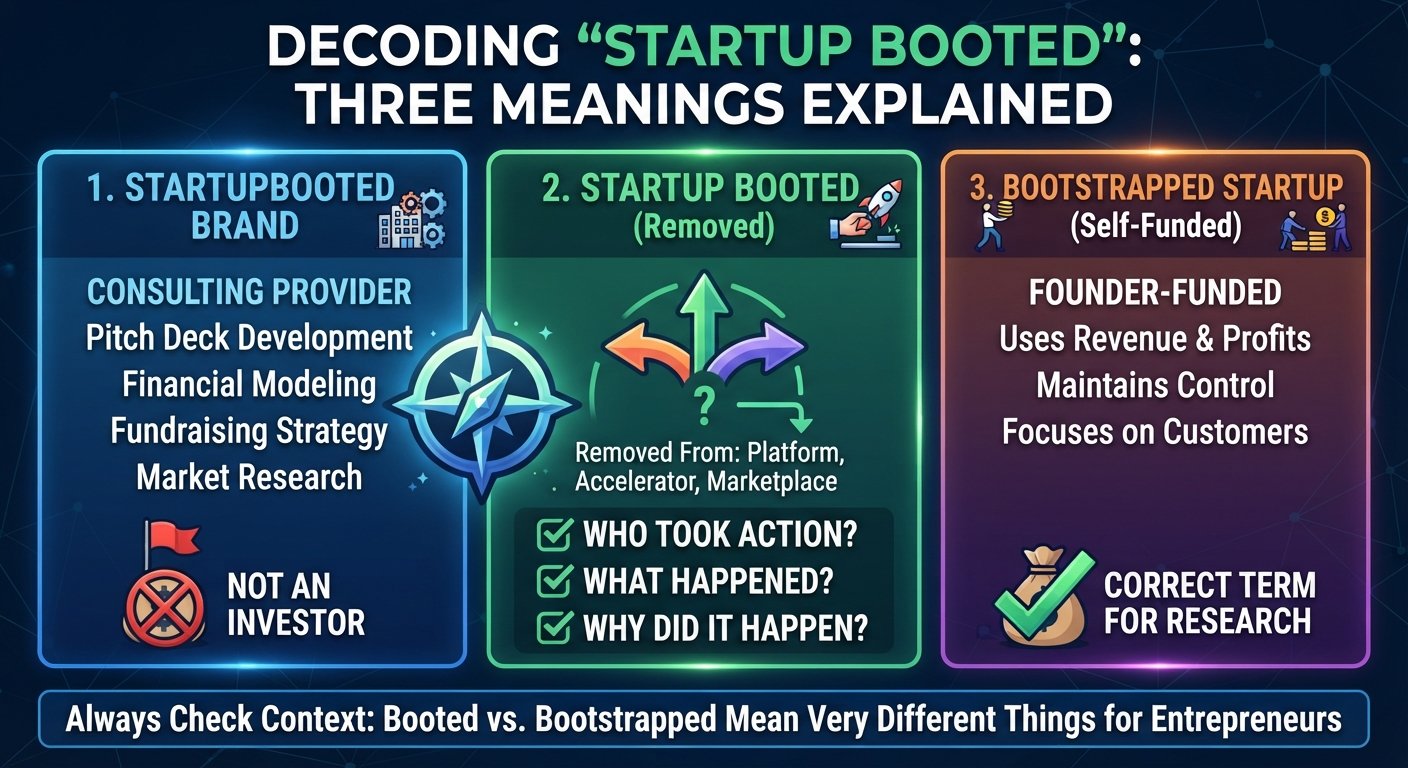
The phrase startup booted can mean different things depending on where you encounter it. It may refer to a startup being removed from a platform or business program, a search for the StartupBooted brand, or confusion with a bootstrapped business that grows using its own resources. Understanding these differences helps entrepreneurs find the information they actually need. Whether you are researching startup funding, looking for professional business support, or learning how founders build companies, this guide explains the terminology, common services, funding approaches, and practical checks worth completing before making a decision.
Quick Answer: Startup booted is an ambiguous search phrase rather than a standard business or financial term. It can relate to a startup being removed from a program, a business or service brand called StartupBooted, or the concept of bootstrapping. The surrounding context determines which meaning applies.
What Does Startup Booted Mean?
The meaning of startup booted depends on the context in which the phrase appears. Unlike established business terms such as bootstrapping, venture capital, and seed funding, startup booted does not have one universally accepted definition.
There are three main interpretations worth understanding.
1. StartupBooted as a Business Brand
Someone searching for startup booted may be trying to find a business website or consulting service. In this context, it is important to distinguish a commercial brand from a general entrepreneurship concept.
A startup consulting provider may offer services such as:
- Investor pitch deck development
- Financial modeling and budgeting
- Business planning and market research
- Fundraising preparation
- Strategic growth advice
These services can help founders organize their business information and prepare for important decisions. However, the exact offerings, pricing, qualifications, and terms depend on the provider.
Before purchasing a service, review its official website, deliverables, revision policy, payment terms, and refund conditions. Do not assume that a consulting provider is an investor simply because it offers fundraising assistance.
2. A Startup Being Booted From a Platform
In informal business language, a startup being booted can mean that its company, founder, product, or account has been removed from a particular environment.
For example, a company might lose access to a marketplace, leave an accelerator after a disagreement, or have an account suspended for violating platform rules.
The phrase alone does not establish why the removal happened. It also does not prove that the business has closed.
When reading a headline about a startup being booted, look for three details:
- Who took the action? Identify the platform, investor, business partner, or organization involved.
- What happened? Determine whether the company lost an account, a partnership, a leadership position, or access to a program.
- Why did it happen? Look for a documented explanation rather than relying on speculation.
These checks help readers distinguish verified events from rumors or misleading headlines.
3. Confusion With a Bootstrapped Startup
Another possible interpretation is a bootstrapped startup. This is a recognized business concept describing a company financed primarily through founder resources, customer revenue, and reinvested profits instead of outside equity investment.
For example, a freelance designer might use personal savings to launch a design agency, secure five paying clients, and reinvest the earnings in better software and additional staff.
The company grows through customer demand rather than depending on an investor to cover every expense.
Although the phrases sound similar, booted and bootstrapped do not mean the same thing. Using the correct term makes business research more accurate.
How Does Startup Bootstrapping Work?
Bootstrapping is a practical funding approach for founders who want to establish a business while maintaining control over spending and ownership.
Instead of raising a large investment immediately, founders build a product or service with available resources, find customers, and use the resulting income to support further development.
Start With a Specific Customer Problem
A business idea becomes more useful when it solves a clear problem for a defined audience.
For example, rather than launching a general marketing agency for everyone, a founder could specialize in helping local restaurants improve their websites and online ordering systems.
A narrow initial market makes it easier to understand customer needs, develop a relevant offer, and communicate value.
Before spending heavily, speak with potential customers and ask about their current problems, existing solutions, and willingness to pay.
Build a Minimum Viable Product
A minimum viable product, or MVP, is an early version of a product that lets a founder test important assumptions without building every planned feature.
A small software company might begin with one useful reporting tool instead of developing a complete business management platform.
A service business could start with one clearly defined package rather than offering dozens of services.
The goal is to learn whether customers value the solution before committing substantial money to expansion.
Find the First Paying Customers
Early revenue provides evidence that people are willing to pay for the product or service.
Founders can test demand through direct outreach, professional networks, targeted content, demonstrations, referrals, or a small advertising campaign.
Track more than the number of interested people. Measure how many become paying customers, how much they spend, and whether they return.
Positive feedback is helpful, but actual purchasing behavior offers stronger evidence of demand.
Reinvest Revenue Carefully
Once sales begin, founders need to decide how to allocate the money they earn.
Possible priorities include:
- Essential software and equipment
- Product improvements
- Customer support
- Marketing channels that produce measurable results
- Contractors or employees who remove a genuine bottleneck
- A cash reserve for unexpected expenses
Reinvesting does not mean spending every dollar that enters the business. Taxes, operating expenses, debt payments, and future obligations must also be considered.
Monitor Cash Flow and Runway
Revenue and profit are not interchangeable. A company can generate substantial sales while still struggling to pay its bills.
A simple cash-flow forecast helps founders estimate when money will enter and leave the business.
For example, suppose a small startup has $12,000 available and expects to spend $3,000 per month. If it has no additional income, that balance represents four months of runway.
The calculation is straightforward:
Runway = Available cash ÷ Monthly net cash burn
This simplified formula assumes a reasonably stable monthly burn rate. Actual runway may change with sales, payment delays, seasonal demand, and unexpected costs.
Review cash flow regularly so that hiring, inventory purchases, and marketing commitments remain affordable.
Startup Booted vs. Bootstrapped vs. Venture-Backed
The terminology becomes easier to understand when the different concepts are compared directly.
| Term | Main meaning | Typical example |
|---|---|---|
| Startup booted | Ambiguous phrase whose meaning depends on context | A company removed from a platform |
| Bootstrapped startup | Business funded primarily through internal resources and revenue | An agency reinvesting client income |
| Venture-backed startup | Business that raises equity capital from outside investors | A software company raising a seed round |
| Startup consulting | Professional advice or services for business development | A founder hiring help with financial forecasts |
Advantages of Bootstrapping
Bootstrapping can be attractive because it allows founders to retain greater ownership and decision-making authority.
Other potential advantages include:
- Less pressure to meet investor growth expectations
- Greater freedom to choose a business direction
- Direct feedback from paying customers
- More disciplined spending habits
- Reduced dilution of founder equity
These advantages are not automatic. A self-funded business still needs sound management, customer demand, and a sustainable financial plan.
Disadvantages of Bootstrapping
The main challenge is that growth depends on the resources available to the business.
Founders may face:
- Limited money for product development
- Slower hiring and expansion
- Personal financial exposure
- Fewer resources to compete with well-funded companies
- Greater difficulty absorbing unexpected losses
A business that requires expensive equipment, regulatory approvals, or extensive research may need a different funding strategy.
When Outside Investment Makes Sense
External investment may be appropriate when a business has demonstrated demand but needs substantial capital to pursue a time-sensitive opportunity.
For example, a company with a proven product might need funding to expand production, enter new markets, or hire a specialized engineering team.
The decision should depend on the business model, expected return, financial risk, and terms offered by investors—not on the assumption that every startup must raise money.
A founder can also explore alternatives such as grants, customer prepayments, carefully structured loans, or strategic partnerships. Each option has its own eligibility requirements and financial consequences.
What Services Can Help a Startup Grow?
Founders do not always need to hire a consultant. However, specialized support can be useful when a specific task exceeds the team’s experience or available time.
Investor Pitch Deck Development
A pitch deck presents the business opportunity, customer problem, solution, market, business model, traction, team, and funding requirements.
A useful deck should explain why the opportunity matters and support important claims with credible evidence.
Before hiring a designer or consultant, prepare the underlying business information. No presentation can compensate for unclear customer demand or unsupported financial assumptions.
Financial Modeling and Budgeting
Financial modeling helps founders examine potential revenue, costs, cash requirements, and future scenarios.
A practical model should include assumptions about pricing, sales volume, operating expenses, customer acquisition, and payment timing.
For instance, a subscription business should estimate how new customers, cancellations, and average revenue per customer affect monthly income.
Ask consultants to explain their assumptions and make the model understandable enough for your team to update after the engagement ends.
Fundraising Strategy
Fundraising preparation involves identifying suitable investors, defining the capital requirement, organizing business records, and preparing for investor questions.
A founder should know how much money is needed, what milestone the funding will support, and how progress will be measured.
Be cautious of anyone who guarantees investment, promises a particular valuation without evidence, or pressures you to pay before providing a clear scope of work.
Professional assistance can improve preparation, but it cannot guarantee that an investor will commit money.
Market Research and Business Planning
Market research helps determine whether a target audience has a meaningful problem and whether the proposed solution can compete.
Useful research may cover customer interviews, competitor pricing, distribution channels, market regulations, and alternatives customers already use.
A business plan should translate these findings into practical decisions about positioning, operations, sales, and finances.
Avoid treating broad market-size estimates as proof that your particular product will attract customers.
How to Evaluate a Startup Consulting Provider
If your search for startup booted leads to a consulting brand, evaluate it using a consistent process rather than relying solely on its marketing.
Step 1: Confirm the Provider’s Identity
Find the official website and verify the business name, contact details, service descriptions, and relevant legal information.
Check whether the provider identifies the people responsible for delivering the work and whether their experience matches your requirements.
Step 2: Request a Clear Scope of Work
A professional proposal should explain what you will receive, when it will be delivered, how revisions work, and what information you must provide.
For a financial model, for example, the deliverable might include an editable spreadsheet, documented assumptions, and several financial scenarios.
For a pitch deck, it might specify the number of slides, design revisions, and whether research or financial analysis is included.
Step 3: Review Evidence of Experience
Look for relevant case studies, verifiable client references, and examples of previous work.
Distinguish between a provider’s own claims and evidence independently supported by clients or other reliable sources.
Client logos, testimonials, and polished examples can be useful starting points, but none independently guarantees the quality of future work.
Step 4: Compare Total Costs
Compare proposals on deliverables and value, not just the headline price.
Consider whether the quoted fee includes research, revisions, implementation support, taxes, or ongoing assistance.
A lower-priced service may be suitable for a simple task, while a complex financial or fundraising project may require more extensive work.
Step 5: Read the Agreement Before Paying
Check the payment schedule, cancellation terms, refund policy, confidentiality provisions, ownership of completed materials, and any recurring fees.
Never assume that a service guarantees funding or business success unless the written agreement clearly establishes the relevant obligation—and even then, understand its limitations.
Common Mistakes Founders Should Avoid
Early-stage businesses can lose valuable time and money through preventable decisions.
Building before validating demand: Developing a large product without customer research increases the risk of investing in features nobody needs.
Confusing revenue with profit: Sales figures alone do not reveal whether a company can cover its operating costs.
Hiring too early: Additional employees increase fixed expenses before the business may have enough reliable income to support them.
Treating a pitch deck as a business strategy: A persuasive presentation is useful, but the company still needs a credible product, market, and operating plan.
Believing every funding promise: Funding decisions depend on investors, business performance, risk, and market conditions. No consultant can guarantee the outcome of an independent investor decision.
Using unclear terminology: Searching for the exact company name or established business concept can prevent confusion and lead to more relevant information.
The most effective approach is to verify information, test assumptions, and make decisions based on the actual needs of the business.
Frequently Asked Questions
What does startup booted mean?
Startup booted is an ambiguous phrase that may refer to a startup being removed from a platform or program, a business brand, or confusion with a bootstrapped startup. The surrounding context determines the intended meaning.
Is StartupBooted the same as a bootstrapped startup?
No. StartupBooted may be used as a brand name, while a bootstrapped startup is a business funded primarily through founder resources and business revenue. The terms should not be treated as interchangeable without supporting context.
Can you start a business without investors?
Yes. Many businesses begin with founder savings, customer payments, and reinvested profits. The approach works best when initial costs are manageable and the company can validate demand without requiring substantial upfront capital.
Is bootstrapping better than venture capital?
Neither approach is universally better. Bootstrapping can preserve ownership and control, while venture capital can provide resources for faster expansion. The appropriate choice depends on the business model, capital requirements, growth opportunities, and the founder’s goals.
Should a startup hire a consulting service?
A consultant may be worthwhile when the business needs specialized help with financial planning, market research, pitch materials, or another defined task. Compare providers, verify relevant experience, and agree on measurable deliverables before paying.
Conclusion
Understanding startup booted begins with identifying what the phrase refers to. It may describe a business being removed from a particular environment, relate to a StartupBooted brand, or arise from confusion with the established concept of bootstrapping.
For founders, the larger lesson is to focus on evidence rather than terminology alone. Validate customer demand, monitor cash flow, choose funding that fits your goals, and evaluate professional services carefully before committing money.
Ready to take the next step? Define your most important business challenge, set a measurable goal, and compare the practical options available before investing your time or budget. A clear plan and informed decisions are a stronger foundation for sustainable startup growth.
