
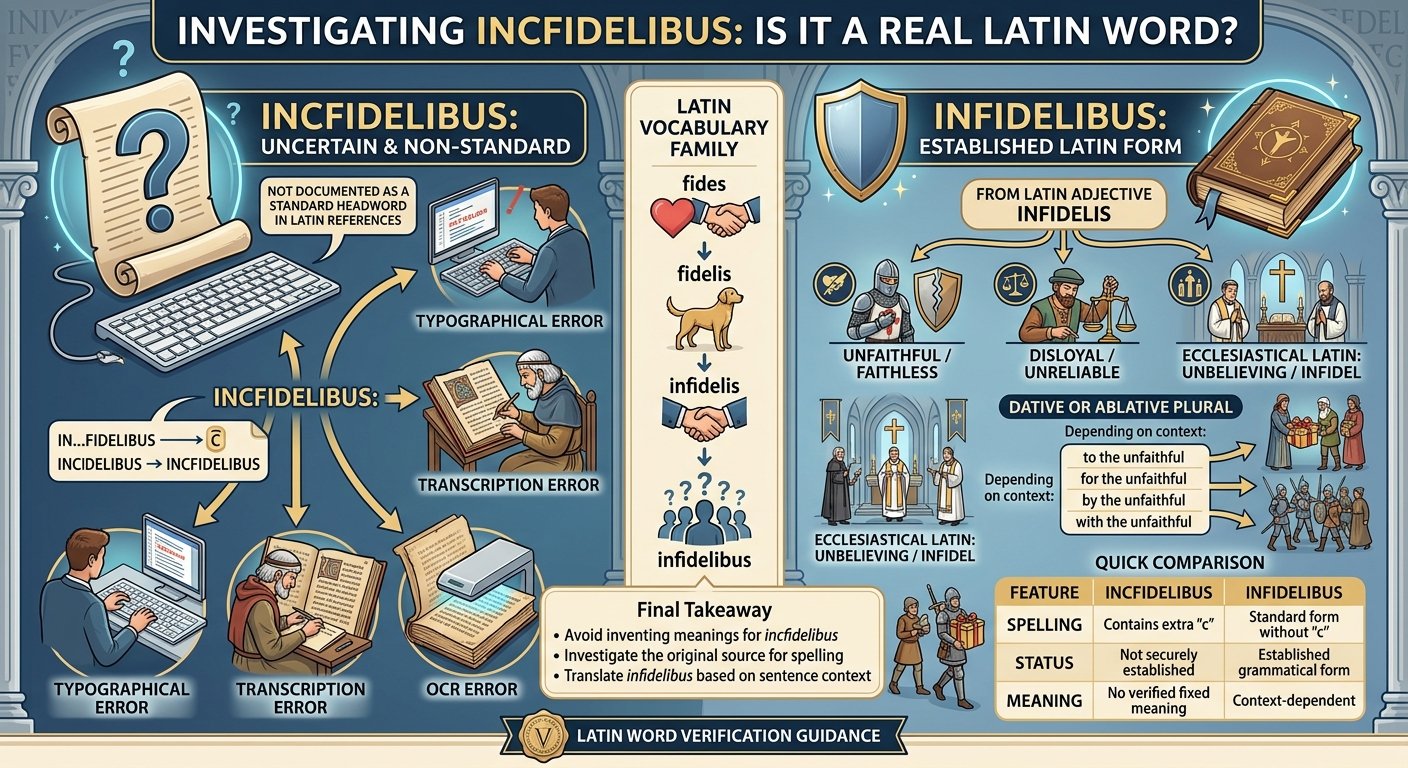
If you have searched for incfidelibus, you may be wondering whether it is an ancient Latin word, a religious expression, or simply an unusual spelling. The safest answer is that incfidelibus is not established as a standard Latin word in the major references examined. It closely resembles the documented form infidelibus, which comes from the Latin adjective infidelis. That genuine Latin word can mean unfaithful, faithless, disloyal, or, in ecclesiastical Latin, unbelieving.
Quick Answer: Incfidelibus does not have a securely established independent Latin definition. The closest documented form is infidelibus, the dative or ablative plural of infidelis. Its translation depends on context but can convey ideas such as “to/for the unfaithful” or “by/with the unfaithful.”
What Does Incfidelibus Mean?
The first thing to understand is the difference between incfidelibus and infidelibus.
The spelling incfidelibus, with a c, is not supported by the established Latin dictionary evidence I found as a standard headword or normal grammatical form. By contrast, infidelis is well documented in major Latin references.
Lewis and Short defines infidelis with senses including “that cannot be relied upon,” “unfaithful,” and “faithless.” It also records an ecclesiastical Latin sense meaning “unbelieving” or “infidel.”
So, when someone searches for incfidelibus meaning, the most useful approach is not to invent a definition for the unusual spelling. Instead, investigate the established Latin form it most closely resembles: infidelibus.
The basic distinction
| Spelling | Status | General meaning |
|---|---|---|
| fidelis | Established Latin | faithful, loyal |
| infidelis | Established Latin | unfaithful, faithless, disloyal |
| infidelibus | Established grammatical form | to/for or by/with the unfaithful, depending on context |
| incfidelibus | Not established as standard Latin | Uncertain; likely a nonstandard spelling or corruption |
This distinction is important if you are researching Latin, translating an old text, or trying to understand where a word came from.
The Real Latin Word: Infidelibus
The strongest linguistic clue behind incfidelibus is infidelibus.
The latter is not a standalone dictionary lemma in the same way that infidelis is. Rather, it is an inflected form of infidelis.
Latin changes the endings of words according to grammatical function. For a third-declension adjective such as infidelis, the ending -ibus can indicate the dative plural or ablative plural. A Latin inflection reference likewise lists infidelibus as both dative plural and ablative plural.
That means there is not necessarily one English translation that works in every sentence.
Depending on context, infidelibus may be rendered along the lines of:
- to the unfaithful
- for the unfaithful
- by the unfaithful
- with the unfaithful
- among the unbelieving
The surrounding Latin sentence determines the best translation.
Why this matters
A common mistake is to treat every Latin word as though it has one fixed English equivalent. Latin case endings carry grammatical information that English often expresses with separate words such as to, for, by, with, or from.
So translating infidelibus correctly requires looking at the complete sentence, not just the isolated word.
Where Does Infidelis Come From?
To understand infidelibus, it helps to go one step further and look at infidelis.
The word belongs to a Latin vocabulary family associated with fides, a word connected with faith, trust, confidence, and good faith.
From this family comes fidelis, meaning faithful or trustworthy. The negative form infidelis expresses the opposite idea.
Lewis and Short records infidelis in general Latin with meanings related to being unreliable, unfaithful, or faithless. It also records a specific ecclesiastical use involving unbelief.
A simplified progression looks like this:
fides → fidelis → infidelis → infidelibus
This does not mean every modern explanation of incfidelibus is historically correct. It simply shows why infidelibus is the most relevant documented Latin form when investigating the unusual spelling.
Is Incfidelibus a Real Latin Word?
Based on the references reviewed, incfidelibus should not be presented as an established classical Latin word.
That does not mean the sequence of letters could never appear in a historical document. A manuscript, transcription, scanned book, OCR output, or modern webpage can contain errors or unusual spellings.
The important distinction is between:
- A word appearing somewhere, and
- A word being an established form in the language.
For infidelis, there is strong dictionary evidence. For infidelibus, there is grammatical evidence as an inflected form. For incfidelibus, the evidence does not establish an equivalent standard Latin form.
That is why a careful explanation should describe incfidelibus as uncertain or nonstandard, rather than confidently assigning it a historical definition.
Why Does the Extra “C” Cause Confusion?
The difference is only one letter:
infidelibus
incfidelibus
That small change can completely alter how a search engine, reader, or translator interprets the word.
There are several plausible explanations for an unusual spelling like this:
1. Typographical error
The simplest explanation is an ordinary typing mistake. Someone may have inserted a c and later copied the resulting spelling.
2. Transcription error
If the term was copied from handwriting or an old printed source, a transcription mistake could have produced an unfamiliar form.
3. OCR error
Digitized books are frequently processed with optical character recognition. OCR systems can misread characters, particularly in older typography, damaged scans, or unusual fonts.
4. Online repetition
Once an unusual spelling appears on a webpage, other sites can reproduce it. Eventually, repeated appearances may make an error appear more authoritative than its original evidence warrants.
This is why search-result frequency alone is not proof that a word is historically genuine.
Incfidelibus vs. Infidelibus
If you encountered the two forms and are unsure which one to research, this comparison is useful:
| Feature | Incfidelibus | Infidelibus |
|---|---|---|
| Spelling | Contains extra c | Standard form without c |
| Established Latin reference | Not securely established | Yes |
| Related lemma | Uncertain | infidelis |
| Grammar | No standard formation established | Dative/ablative plural |
| Meaning | No independently verified fixed meaning | Context-dependent |
| Best use for research | Investigate the source | Use as the documented Latin form |
The key point is not simply that one spelling “looks right.” It is that infidelibus can be traced through established Latin vocabulary and grammar.
What Does Infidelibus Mean in Context?
Because infidelibus is an inflected form, context matters.
For example, if a Latin sentence uses the dative plural, the sense may involve “to” or “for” the people described by infidelis.
If it uses the ablative plural, the translation may instead involve “by,” “with,” or another English construction appropriate to the sentence.
This is why simply copying a dictionary definition into a translation can produce an awkward or incorrect result.
A better method is:
- Identify the base word: infidelis.
- Identify the grammatical form: infidelibus.
- Determine whether it is dative or ablative.
- Read the surrounding sentence.
- Choose the English wording that fits that context.
This approach is much more reliable than treating the word as an isolated vocabulary item.
Is Infidelis Religious?
It can be, but not exclusively.
The historical dictionary evidence shows that infidelis was used more broadly to describe someone or something unfaithful or unreliable. Lewis and Short also records an ecclesiastical Latin sense involving someone who is unbelieving.
Therefore, it would be inaccurate to say that the word has only a religious meaning.
Its interpretation depends on the period and context in which it appears.
In a classical or general Latin context, the word can concern faithfulness, reliability, or trust. In ecclesiastical contexts, it can take on a more specifically religious meaning.
How to Verify Incfidelibus Yourself
If you encounter incfidelibus in a book, manuscript, website, or document, you can investigate it without immediately accepting the first definition you find.
Step 1: Copy the exact spelling
Write down the word exactly as it appears, including unusual letters.
Step 2: Check the surrounding sentence
A Latin word’s grammatical function often becomes clear only when you see the complete sentence.
Step 3: Search the closest established form
Compare incfidelibus with infidelibus and infidelis.
Step 4: Check a reputable Latin dictionary
Resources based on established dictionaries are preferable to pages that provide an unexplained definition.
The Lewis & Short entry for infidelis, for example, provides historical senses and citations from authors including Cicero, Caesar, Horace, Plautus, and Pliny.
Step 5: Look for the original source
If the word comes from a scanned historical document, examine the original image where possible. This can reveal whether the unusual c was actually printed or introduced during transcription/OCR.
Common Misunderstandings About Incfidelibus
Several assumptions should be avoided when researching this term.
“It looks Latin, so it must be Latin.”
Not necessarily. Modern inventions, errors, usernames, website names, and corrupted text can all look convincingly Latin.
“It appears online many times, so it must be historically authentic.”
Online repetition is not the same as dictionary or manuscript evidence.
“Infidelibus has one exact English translation.”
Not always. Its grammatical case means the surrounding sentence affects the appropriate translation.
“Incfidelibus and infidelibus are automatically identical.”
They are not literally the same spelling. The evidence instead supports treating infidelibus as the established form when the intended word is the Latin term derived from infidelis.
Frequently Asked Questions
What does incfidelibus mean?
Incfidelibus has no securely established independent meaning as a standard Latin word. It closely resembles infidelibus, a documented Latin form derived from infidelis.
Is incfidelibus a real Latin word?
The spelling incfidelibus is not established as a standard Latin form in the authoritative references reviewed. The documented form is infidelibus, without the extra c.
What does infidelibus mean in Latin?
Infidelibus is the dative or ablative plural of infidelis. Depending on context, it can be translated along the lines of “to/for the unfaithful” or “by/with the unfaithful.”
What does infidelis mean?
Infidelis is a Latin adjective meaning unfaithful, faithless, unreliable, or not to be trusted. In ecclesiastical Latin, it can also mean unbelieving.
Why does incfidelibus appear online?
The exact origin of the unusual spelling is not securely established. A typographical, transcription, OCR, or copying error is a reasonable explanation, but the original source would need to be examined before claiming a specific origin.
Final Takeaway
The most important distinction is simple: incfidelibus and infidelibus should not be treated as equally established Latin forms.
The spelling incfidelibus does not have a securely documented independent definition in the references examined. The much stronger linguistic evidence points to infidelibus, the dative or ablative plural of infidelis. That underlying adjective has documented meanings involving unfaithfulness, faithlessness, unreliability, and, in ecclesiastical Latin, unbelief.
If you encountered incfidelibus in a historical document, don’t automatically assume the unusual spelling represents a special Latin word. Check the original passage, compare it with infidelibus, and verify the grammar before translating it.
