
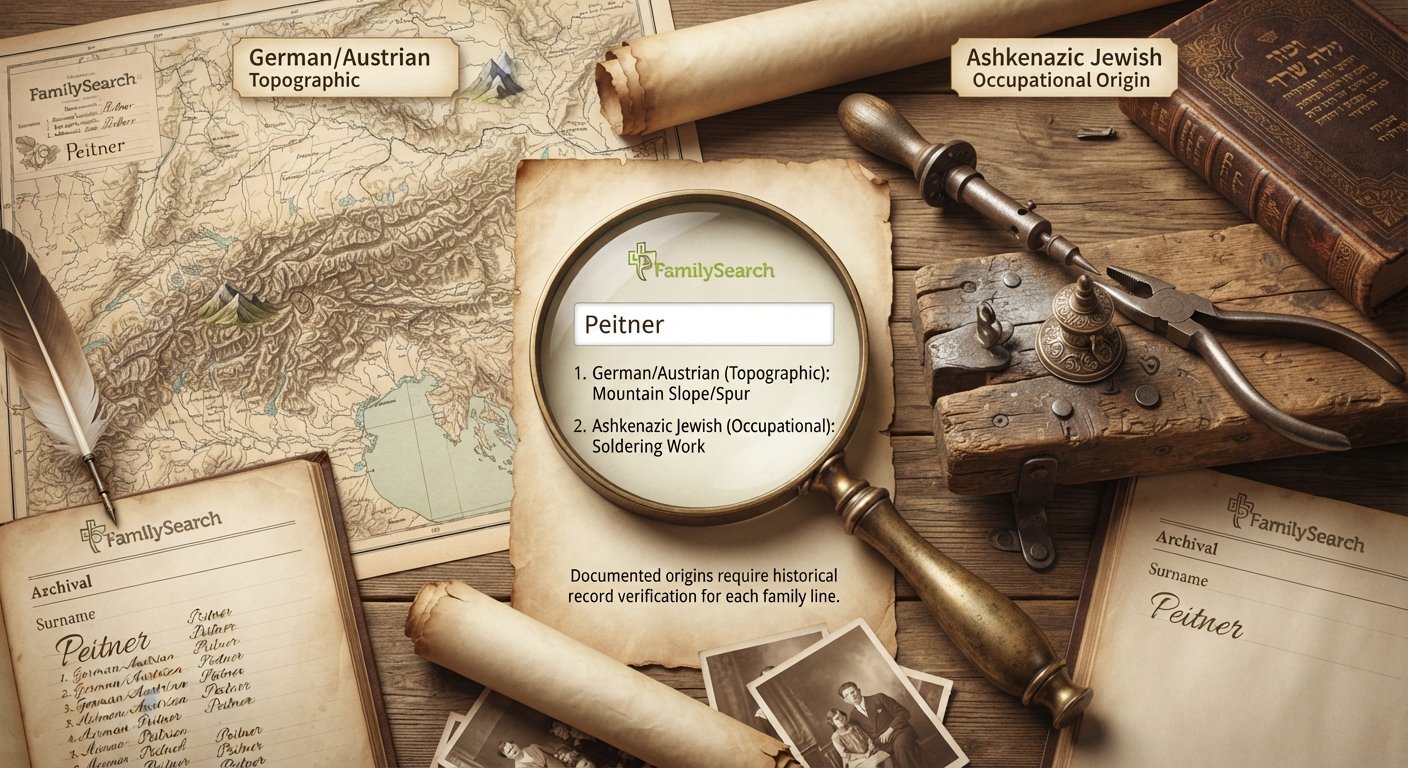
If you are researching Peitner, the name is best understood as a rare surname with more than one documented possible origin. FamilySearch, drawing on the Dictionary of American Family Names, identifies a German/Austrian topographic explanation connected with a mountain slope or spur, while a separate Ashkenazic Jewish interpretation connects the name with soldering work. The important point is that not every Peitner family necessarily shares the same origin.
Quick Answer:
Peitner is primarily a rare family surname. Its documented origins include a German/Austrian topographic interpretation associated with a mountain slope or spur and a separate Ashkenazic Jewish occupational interpretation connected with soldering. Your own family’s origin must be established through historical records rather than the surname alone.
What Does the Peitner Surname Mean?
Peitner is not an everyday English vocabulary word. It is primarily encountered as a family name, particularly in genealogical and historical records.
The most useful established source currently available is FamilySearch, which cites the Dictionary of American Family Names. It gives two distinct explanations rather than claiming there is only one universal meaning.
The first explanation is German and Austrian. It classifies Peitner as a topographic surname associated with someone who lived by a mountain spur or on a slope. The explanation connects the name with Middle High German līte, referring to a mountain slope or spur, combined with a suffix indicating an inhabitant.
The second explanation is associated with Ashkenazic Jewish naming traditions. In that interpretation, the surname is connected with the Yiddish leytn, meaning “to solder,” making it an occupational surname associated with metalworking.
These should be treated as separate possible origins, not automatically combined into one family story.
Peitner at a Glance
| Feature | Details |
|---|---|
| Name type | Surname / family name |
| Main research area | Genealogy and family history |
| German/Austrian interpretation | Topographic |
| Landscape connection | Mountain slope or spur |
| Separate Jewish interpretation | Occupational |
| Occupational connection | Soldering / metalworking |
| Important regions | Bavaria and Austria, with wider Central European connections |
| Related spellings to investigate | Peintner, Peithner and other variants |
| Best evidence | Birth, marriage, death, census, immigration and archival records |
FamilySearch currently lists thousands of historical records associated with the Peitner surname, making genealogy databases a useful starting point for further research.
Is Peitner a German Surname?
Peitner has documented German and Austrian surname connections, but describing every Peitner family simply as “German” would be too broad.
The historical regions of Central Europe did not have today’s political borders. Communities in Bavaria, Austria, Tyrol, and neighboring areas could experience changes in administration, language, and national boundaries over generations.
This is especially important when researching old family records.
An ancestor may have lived in a German-speaking Alpine community, for example, while the same region later became part of a different modern state. As a result, the nationality written on a modern family tree may not match the historical location where a surname originated.
Why Geography Matters
Surname research works best when you separate:
- Surname origin
- Place of residence
- Nationality
- Language
- Family ancestry
These are related but not identical.
A surname can originate in one region and later spread through migration. Similarly, two families with the same surname can have different origins.
The Topographic Origin of Peitner
The German/Austrian explanation is particularly interesting because it connects the name with the landscape.
A topographic surname is a family name derived from a geographical feature or the location where someone lived.
Before modern street addresses and standardized identification systems, communities needed practical ways to distinguish people with similar first names. A person’s home or surroundings could become part of their identity.
Someone might be identified by:
- A hill
- A valley
- A forest
- A river
- A mountain
- A particular settlement
- A distinctive piece of land
Over time, such descriptions could become inherited surnames.
Under the documented Peitner interpretation, the name’s connection to a mountain slope or spur fits this broader European naming pattern.
What Does a Topographic Surname Tell You?
It can provide a clue, but not an exact address.
If your family name is Peitner, you should not assume that your ancestors definitely lived on one specific mountain simply because the surname has a topographic interpretation.
The surname meaning tells you about a possible naming tradition. Historical records are needed to identify the actual family location.
The Ashkenazic Jewish Occupational Origin
The second documented explanation takes a completely different route.
FamilySearch records an Ashkenazic Jewish occupational interpretation connected with the Yiddish word leytn, meaning “to solder,” along with an agent-forming suffix.
Occupational surnames developed from people’s trades or professions.
This naming pattern is common across many cultures. A person associated with a particular craft could eventually pass that occupational name to later generations.
For a Peitner family connected to this interpretation, the surname could therefore have originated from an ancestor involved in soldering or related metalworking.
But there is an important limitation.
One Surname Does Not Prove One Ancestry
Finding the surname Peitner in your family tree does not prove that your ancestors were connected to the occupational explanation.
The same modern spelling can emerge from different linguistic or cultural traditions.
That is why serious genealogy focuses on documentary evidence rather than assuming that a surname definition automatically identifies an individual’s ancestry.
Peitner and Central European History
The Peitner surname is particularly interesting because its documented explanations intersect with the history of Central Europe.
German-speaking regions developed extensive traditions of hereditary surnames over many centuries. Mountainous areas of Bavaria, Austria, and neighboring Alpine territories also produced many surnames connected with geography and local landscapes.
Meanwhile, Ashkenazic Jewish communities developed their own naming traditions, including occupational and geographic surnames.
These different historical environments help explain why one surname can have more than one documented etymological pathway.
Current genealogical sources list Peitner records in several European countries, including Germany, Hungary, and Croatia, while the broader historical discussion connects the name with German-speaking Central Europe.
Peitner, Peintner, and Peithner: Are They the Same?
One of the most important parts of Peitner genealogy is spelling variation.
Historical documents were not always standardized. A surname might be recorded differently depending on:
- The language of the document
- The person recording the information
- Local pronunciation
- Handwriting
- Migration
- Translation
- Changes in administrative borders
This means researchers should not search only for the exact spelling Peitner.
Useful Variant Searches
When researching your family, also consider searching for:
- Peintner
- Peithner
- Similar-looking historical spellings
- Phonetic variations
However, similar spelling does not automatically prove that two families are related.
A spelling variant becomes meaningful when it appears alongside matching locations, dates, parents, spouses, occupations, or other genealogical evidence.
How to Research Your Peitner Family History
If Peitner is your surname or appears in an ancestor’s records, a structured approach can save considerable time.
1. Start With the Most Recent Known Relative
Begin with information you can verify.
Record:
- Full name
- Birth date
- Birthplace
- Marriage information
- Death date
- Residence
- Parents
- Spouse
- Children’s names
Do not begin by assuming the surname’s general origin is your family’s specific origin.
2. Work Backward Through Records
Once you have a documented person, move backward one generation at a time.
Useful sources include:
- Birth certificates
- Baptismal records
- Marriage certificates
- Death certificates
- Census records
- Immigration records
- Passenger lists
- Military records
- Church registers
FamilySearch specifically provides access to historical collections that can include census, immigration, military, birth, marriage, and death information.
3. Search Spelling Variations
Do not enter only “Peitner.”
Try combinations such as:
Peitner + Austria
Peitner + Bavaria
Peintner + Tyrol
Peithner + family
Peitner + birth record
This can reveal documents that an exact-spelling search misses.
4. Verify Every Connection
Suppose you find a nineteenth-century Peitner in Austria.
That does not automatically mean the person is your ancestor.
Compare:
- Dates
- Places
- Parents
- Spouse
- Children’s names
- Occupation
- Migration records
The more independent details match, the stronger your genealogical conclusion becomes.
5. Build a Source-Based Family Tree
A useful family tree should show where each fact came from.
Instead of writing:
“My ancestor came from Bavaria.”
record something closer to:
“Birth record dated [date] lists [place], Bavaria.”
That distinction is important because family stories can change over generations.
Does Peitner Have a Family Crest?
Be careful with online surname crest and “family coat of arms” websites.
A coat of arms historically belonged to a particular individual, family line, or recognized bearer. Sharing a surname does not automatically mean every person with that surname is entitled to the same arms.
Therefore, if you find a website displaying a “Peitner family crest,” do not immediately treat it as proof of your ancestry.
The stronger approach is to identify the specific historical person or family associated with the arms and then establish whether your documented family line connects to them.
What Can the Peitner Name Tell You?
The surname can provide useful research clues, but it has limits.
It may suggest:
- A Central European connection
- German or Austrian linguistic history
- A possible Alpine geographic origin
- An occupational naming tradition in a separate Ashkenazic context
- Potential spelling variations
It cannot prove:
- Your exact ancestral village
- Your nationality
- Your ethnicity
- Your specific family branch
- That every Peitner family is related
- That one surname meaning applies to every bearer
That distinction is fundamental to responsible genealogy.
Why Peitner Searches Can Produce Conflicting Answers
Rare surnames often create a strange online effect.
A person searches for an unfamiliar name. A website publishes an explanation. Other websites repeat the explanation. Eventually, repetition can make an uncertain claim look like established historical fact.
Peitner is a good example of why source quality matters.
The strongest evidence comes from established genealogical and surname references. FamilySearch’s entry is particularly useful because it identifies the source behind its surname etymology rather than simply presenting an unsupported definition.
Some newer online pages also correctly repeat the two-origin explanation, but the original genealogical reference should remain the foundation of the article.
FAQ About Peitner
What does the surname Peitner mean?
Peitner has more than one documented possible origin. One German/Austrian interpretation connects it with a person living near a mountain slope or spur. A separate Ashkenazic Jewish interpretation connects it with soldering as an occupation.
Is Peitner a German surname?
Peitner has documented German and Austrian connections, particularly in the surname’s topographic interpretation. However, FamilySearch also records a separate Ashkenazic Jewish origin, so the surname should not automatically be assigned to one ancestry.
Where does the Peitner family come from?
There is no single location that can be assigned to every Peitner family. Genealogical evidence connects the name with German-speaking Central Europe, while historical records show Peitner occurrences in several countries. Your specific family origin needs to be established from records.
Are Peitner and Peintner the same surname?
They may be related spelling variants in some family lines, but spelling similarity alone is not enough to establish a relationship. Researchers should compare historical records, locations, dates, and family members before treating the names as equivalent.
How can I research my Peitner ancestry?
Start with the oldest confirmed relative in your family, collect birth, marriage, death, census, immigration, and church records, and then work backward. Search alternative spellings and verify every generation with documentary evidence.
Final Thoughts on the Peitner Surname
Peitner is a rare surname with a more complicated history than its unusual spelling might suggest. The strongest genealogical reference identifies two major possibilities: a German/Austrian topographic origin associated with a mountain slope or spur, and a separate Ashkenazic Jewish occupational interpretation associated with soldering.
The key lesson is not to force every Peitner family into one origin story. Surname etymology provides a starting point; historical records provide the proof.
If you are researching a Peitner ancestor, begin with your closest documented relative, work backward carefully, search spelling variants, and save the source for every major discovery.
