
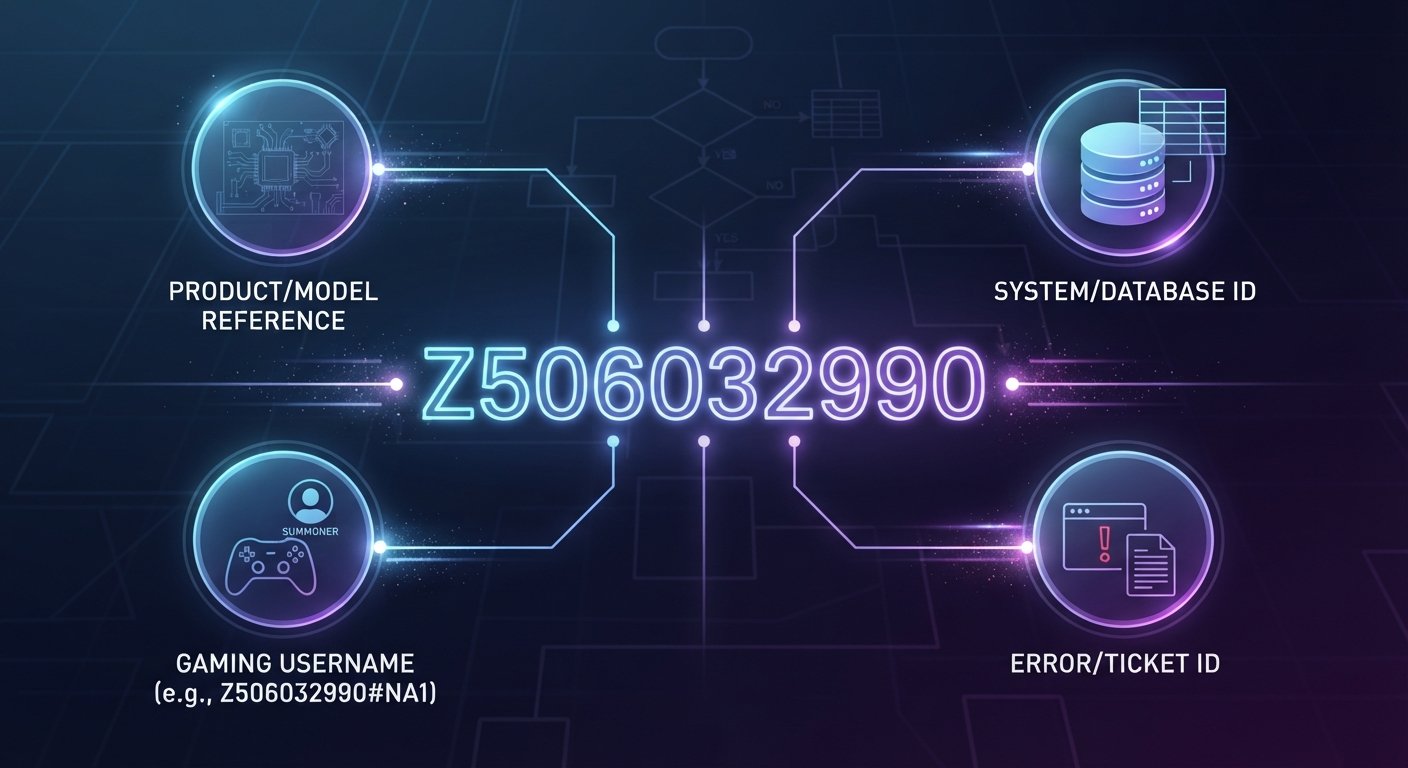
If you searched for z506032990, you are probably trying to identify a code rather than understand a conventional word. Current search results do not establish one universal meaning for this exact string. It appears in several different contexts, including identifier-focused articles, a page claiming it is a product/model identifier, and a League of Legends account using the same string. The safest conclusion is that its meaning depends on where you encountered it.
Quick Answer: Z506032990 is an alphanumeric string whose exact meaning cannot be confirmed from the characters alone. It may function as a system identifier, product/model reference, username, or another internal code. The original source is the key to identifying it accurately.
What Is Z506032990?
Z506032990 is an alphanumeric identifier consisting of one letter followed by nine digits. On its own, the string does not provide enough information to determine what system created it or what object it represents.
This is an important distinction because identifiers are designed primarily for uniqueness and reference, not necessarily for human readability.
A database might use a code like this to point to one record. A manufacturer might assign a similar-looking sequence to a component. A gaming platform can use a comparable string as a username.
Current search results demonstrate exactly this ambiguity.
One page describes z506032990 as a general system-generated identifier, while another claims that Z506032990 represents a specific product or component. Separately, OP.GG indexes Z506032990#NA1 as a League of Legends summoner profile.
Therefore, it would be misleading to claim that the code has one confirmed definition without knowing its original context.
Why the Context Matters
Consider finding the following string in three different places:
Z506032990
If it appears:
- On a product label, it may be a model or part reference.
- In an error message, it may be a ticket or event identifier.
- On a gaming platform, it may be a username.
- In a database export, it may identify a record.
- In a URL, it may be a page or object ID.
- In an email, it may be a reference number.
The characters are identical, but the meaning changes.
That is why identifying an unusual code should begin with source analysis, not speculation.
What Does Z506032990 Mean?
There is currently no independently verified universal definition for z506032990.
One current web page presents it as a generic identifier used in databases, transaction references, logs, inventory systems, and internal tools.
Another page makes a much more specific claim, describing Z506032990 as a product or model identifier potentially used for hardware or industrial components. However, that page does not provide enough manufacturer-level evidence to independently establish the claim as authoritative.
There is also direct evidence that the exact string can appear as part of a gaming identity: OP.GG currently has a profile indexed as Z506032990#NA1 on the North American League of Legends server.
These results demonstrate an important SEO and research lesson:
A search result can establish that a string is being used somewhere, but it does not automatically establish what the string officially means.
Is Z506032990 a Product Number?
Possibly, but this cannot be confirmed from the string alone.
A current search result explicitly describes Z506032990 as a model identifier for a device or component and discusses datasheets, compatibility, electrical specifications, and supplier verification.
However, if you found Z506032990 on physical hardware, do not order a replacement based only on the matching characters.
Instead, verify:
- Manufacturer name
- Complete part number
- Product family
- Revision number
- Serial or lot number
- Datasheet
- Supplier information
A single character can distinguish two technically different components.
Why Exact Part Numbers Matter
Imagine two components with similar labels:
| Identifier | Possible difference |
|---|---|
| Z506032990 | Base model |
| Z506032990-A | Variant |
| Z506032990-R1 | Revision |
| Z506032990-NA | Regional version |
These suffixes are hypothetical examples, but they illustrate why technicians should never assume that visually similar identifiers are interchangeable.
If the code relates to electrical or industrial equipment, confirm voltage, current, interface, dimensions, firmware, and revision information before installation.
Could Z506032990 Be a Username?
Yes.
There is direct evidence of the string being used as part of a League of Legends summoner identity. OP.GG lists Z506032990#NA1 on its North American service and provides historical ranked information and champion mastery associated with that account.
That does not mean the string was originally created as a gaming username.
It simply demonstrates that the same character sequence can have a completely different meaning depending on the platform.
This is particularly important for searches involving unusual alphanumeric keywords.
A person may see the string in:
- A game profile
- A leaderboard
- A forum
- A social-media account
- A URL
- A screenshot
and assume that it represents a technical code.
Sometimes it is simply an account name.
Could It Be a Database or System Identifier?
This is another plausible interpretation.
Modern software systems frequently assign identifiers to objects that humans interact with indirectly.
For example, an application might store:
Record ID: Z506032990
Customer: Example User
Status: Active
Created: 2026-10-08
The ID itself does not need to describe the customer.
Its job is simply to let the software distinguish one record from another.
This approach has several advantages.
Uniqueness
A system can assign different IDs to millions of records without relying on descriptive names.
Stability
A person’s name or product title may change while an internal ID remains unchanged.
Integration
Different systems can use the identifier to reference the same object.
Efficiency
Databases can index compact identifiers efficiently.
For these reasons, an unusual string like z506032990 could theoretically be a database identifier even if it has no obvious linguistic meaning.
How Identifier Codes Are Commonly Generated
The structure of an identifier can sometimes provide clues, but it rarely proves its origin.
Randomly Generated IDs
Some systems generate random alphanumeric values.
The goal is usually to reduce collisions and make identifiers difficult to predict.
Sequential IDs
Other systems assign numbers sequentially:
506032988
506032989
506032990
506032991
If a system adds a letter prefix, the resulting value can resemble an alphanumeric code.
However, there is no evidence that z506032990 was generated this way.
Hash-Based Identifiers
A system may also transform information through a hashing algorithm and use part of the resulting output as an identifier.
This can create values that appear completely meaningless to users.
Prefix-Based Systems
The initial Z could theoretically represent a category, environment, product family, or internal namespace.
But this should not be assumed without documentation.
The same letter can mean entirely different things in different systems.
How to Identify Z506032990 Correctly
If you encountered this code and want a definite answer, use the following process.
Step 1: Go Back to the Original Source
Ask yourself where you first saw z506032990.
Was it:
- A website?
- An email?
- A product?
- A receipt?
- An error message?
- A gaming profile?
- A database?
- A shipping label?
The original location is often the strongest clue.
Step 2: Copy the Code Exactly
Pay attention to:
- Uppercase vs. lowercase
- Hyphens
- Underscores
- Prefixes
- Suffixes
- Spaces
- Additional numbers
For example:
z506032990
is not necessarily the same identifier as:
Z506032990-A
or:
Z506032990#NA1
The OP.GG result demonstrates how the exact string can appear with a platform-specific suffix.
Step 3: Search the Full String
Avoid searching only:
506032990
Search:
"z506032990"
Quotation marks can help identify pages containing the exact sequence.
Then add contextual terms:
"z506032990" product"z506032990" model"z506032990" error"z506032990" username"z506032990" game
This can reveal which interpretation best matches your situation.
Step 4: Check First-Party Sources
If the code appears to be a product identifier, look for the manufacturer’s official documentation.
If it appears to be a gaming account, check the relevant platform.
If it appears in software, check the application’s documentation or support system.
First-party evidence is considerably stronger than a blog simply repeating the code.
Step 5: Compare Independent Evidence
Do not count multiple websites as separate confirmation if they all appear to copy the same information.
This matters particularly for obscure keywords.
Several current pages repeat broad claims about z506032990, but repetition alone does not establish an authoritative source.
Z506032990 and Online Search Results
The current search landscape is unusually fragmented.
A useful way to visualize it is:
| Search context | What current results indicate |
|---|---|
| Generic identifier | Possible system-generated code |
| Product/model | Claimed by one current result |
| Gaming | Confirmed appearance as a League of Legends summoner name |
| Connectivity reports | Appears in several low-context pages |
| Universal definition | Not established |
The gaming interpretation has particularly concrete evidence because a dedicated OP.GG profile exists for Z506032990#NA1.
By contrast, the product interpretation needs additional manufacturer documentation before it should be treated as confirmed.
This distinction is important for anyone writing about the keyword.
A strong article should not manufacture certainty simply because a low-volume query needs an answer.
What Should You Do If Z506032990 Appears in an Error?
If you encountered the code in an error message, do not immediately assume it identifies a product.
Error and support systems frequently generate reference numbers so technicians can locate the relevant event in their logs.
Save:
- The complete error message
- The exact code
- Date and time
- Application or website name
- Device used
- Steps that caused the error
- Screenshot, if available
Then contact the service provider’s support team.
Give them the complete identifier rather than only the numeric portion.
A support agent may be able to use the reference to find the corresponding server-side event.
Is Z506032990 Safe to Share?
That depends on what the identifier represents.
A random-looking code may be harmless, but you should not automatically assume that every identifier is public information.
Some identifiers can provide access to:
- Support cases
- Private documents
- Orders
- Accounts
- Internal records
- Temporary authentication workflows
If the code appears alongside a private URL, login information, password-reset link, payment information, or account details, avoid publishing the complete information publicly.
The safest rule is simple:
Share an identifier only when you understand what system generated it and whether it is intended to be public.
What Z506032990 Is Not Proven to Be
Based on the available evidence, several conclusions would be premature.
It is not proven to be one specific product
One current page makes that claim, but additional manufacturer-level evidence is needed.
It is not proven to have one universal technical meaning
The same string appears in unrelated online contexts.
It is not necessarily an error code
It could be an account name, record ID, product identifier, or something else.
It is not necessarily a secret or encrypted message
Alphanumeric identifiers often have no human-readable meaning at all.
It is not necessarily connected to every page that mentions it
Search engines can surface pages that include the same string without those pages referring to the same underlying entity.
A Better Way to Think About Z506032990
Rather than asking:
“What does this code mean?”
ask:
“What system created this code, and what object does that system associate with it?”
That question is much more useful.
For example:
Product label → manufacturer → model → datasheet
Game profile → platform → account → player statistics
Error message → application → event → support record
Database → table → record → associated fields
The code itself is only the starting point.
Its surrounding context provides the actual meaning.
Frequently Asked Questions
What is z506032990?
Z506032990 is an alphanumeric string whose exact purpose is not universally established. Current search results associate it with different contexts, including generic identifiers, a claimed product/model reference, and a League of Legends summoner name.
What does z506032990 mean?
Its meaning depends on where it was found. Without the original source, it is not possible to reliably determine whether it represents a product, record, username, transaction, or another system-generated reference.
Is z506032990 a product or model number?
One current web source describes Z506032990 as a product/model identifier, but this claim should be independently verified through manufacturer documentation before the code is used for purchasing or equipment replacement.
Is z506032990 a username?
It can be. OP.GG currently indexes Z506032990#NA1 as a League of Legends summoner identity on the North American server.
How can I verify what z506032990 refers to?
Return to the source where you found it, copy the complete identifier, and search it together with contextual terms. For technical products, check manufacturer documentation; for gaming profiles, use the relevant gaming platform; for errors, contact the application’s support team.
Conclusion
Z506032990 does not currently have one reliably established meaning. The exact string appears in several online contexts, including general identifier discussions, a page claiming it is a product/model number, and a League of Legends profile.
That makes context more important than the code itself.
If you found z506032990 on a product, investigate the manufacturer and full part number. If it appeared in a game, check the account or platform. If it appeared in an error message, preserve the complete reference and give it to support.
Most importantly, do not assume that a repeated claim on multiple websites is proof of an identifier’s official meaning. For obscure alphanumeric searches, first-party documentation and the original source remain the strongest evidence.
